Table of Contents
Boosting IVF Success Rates with AI-Powered Embryo Selection
AI-Powered Embryo Selection
Embryo selection is one of the most critical steps in the IVF journey—it’s how we choose the single embryo with the greatest chance of implanting and developing into a healthy pregnancy.
At Metro IVF, we’re proud to offer cutting-edge, AI-powered selection tools that go far beyond what the naked eye can see, greatly enhancing the embryo grading process. The higher the embryo quality, the greater your chances of a successful transfer and IVF outcome. Here’s a friendly, easy-to-understand guide to how these technologies work—and why they matter for your journey.
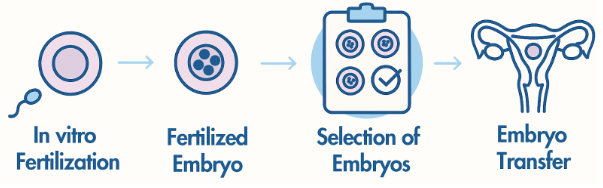
Why select embryos?
Every embryo has its own story. Traditional grading methods rely on quick visual checks under a microscope—looking at cell number, symmetry and fragmentation at a single point in time. While helpful, these “snap-shots” can miss important developmental events, and grading can vary from one embryologist to another. Advanced tools help us:
- Increase pregnancy rates by choosing embryos with the strongest growth patterns.
- Reduce time to pregnancy by avoiding transfers of embryos with low implantation potential.
- Minimize embryos transferred (lowering multiple-pregnancy risks) by improving confidence in the “one best embryo.”
From morphology to data-driven selection
Rather than a once-a-day glance, today’s options let us continuously monitor and analyze embryos, ultimately leading to higher successful pregnancy rates:
Time-Lapse Embryo Imaging
- How it works: A tiny camera inside a special incubator takes photos every 5–15 minutes without disturbing the embryo’s environment.
- Why it helps: Captures subtle events—like abnormal cell divisions or “direct cleavage”—that you’d otherwise miss.
- Patient benefits: Up to a 10% increase in chance of pregnancy with the first transfer, plus less overall handling stress on embryos.
AI-Powered Embryo Selection
- How it works: Sophisticated algorithms “learn” from hundreds of time-lapse images per embryo, recognizing growth patterns and shapes linked to highest implantation success.
- Why it helps: More objective than human grading alone—AI can spot tiny cues in cell behavior invisible to the eye.
- Patient benefits: Faster, more confident selection of the single best embryo; potential for non-invasive chromosomal assessment, reducing need for embryo biopsy.
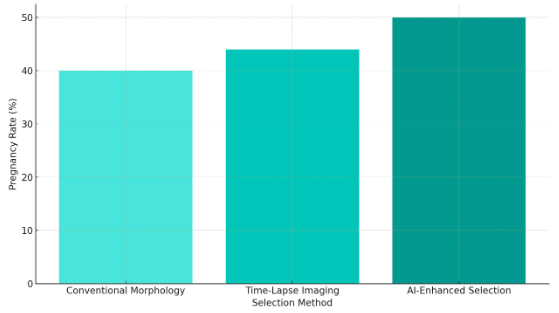
Figure showing clinical pregnancy rates based on different embryo selection methods (VerMilyea et al., 2020)
Beyond the embryo: complementary tools
While embryo selection is key, Metro IVF also offers other advanced assessments to optimize your cycle:
- Genetic Testing (PGT-A): A biopsy-based test to check for chromosomal abnormalities.
- Non-Invasive Embryo Assessment: Emerging AI approaches that predict chromosomal health from images alone.
- Endometrial Receptivity Analysis (ERA): A molecular test (236-gene panel) to find the best day in your cycle for transfer—so a top embryo meets a “ready” uterus.
Myths about embryo selection
Myths often arise from oversimplifying a very complex biological process. By separating myth from reality, you’ll have a clearer understanding of what modern embryo-selection tools can—and can’t—do. Metro IVF’s team of expert embryologists and fertility specialists are always happy and fully equipped to help you understand and debunk these myths every step of the way.
- Myth: A “Grade A” embryo guarantees pregnancy
Debunked: While embryos that “look good” are encouraging, they’re not infallible. Even top-graded embryos can fail to implant, and lower-graded ones sometimes lead to healthy babies. That’s why Metro IVF combines grading with time-lapse and AI analysis to get a fuller picture of each embryo’s potential.
- Myth: More cells at Day 3 means a better embryo
Debunked: Embryo health isn’t just about cell count but also about division timing and symmetry. An embryo that divides too quickly or unevenly may have underlying issues. Continuous monitoring and AI help us evaluate both the pace and quality of those divisions.
- Myth: Mosaic embryos (mixed normal + abnormal cells) should always be rejected
Debunked: Some mosaic embryos self-correct and result in perfectly healthy pregnancies. Discarding them outright can limit your options. Our team reviews mosaic results case-by-case and offers genetic counselling so you can make an informed decision.
- Myth: If an embryo looks “perfect” under the microscope, genetic testing isn’t needed
Debunked: Morphology can’t reveal chromosomal errors. An embryo that appears ideal may still carry genetic abnormalities. That’s why we recommend preimplantation genetic testing (PGT-A) or non-invasive AI assessments alongside visual grading.
- Myth: Time-lapse imaging or AI guarantees a baby on the first transfer
Debunked: These technologies improve selection accuracy—boosting pregnancy odds by 10–15 %—but they can’t control every factor. Uterine receptivity, sperm quality and maternal health also play vital roles in success.
- Myth: Once AI is involved, embryologists are no longer needed
Debunked: AI is a powerful decision-support tool but not a replacement for human expertise. Our embryologists review AI scores in the context of your medical history and cycle details, ensuring that every decision remains personalized.
We Are Happy To Help
At Metro IVF, our state-of-the-art labs, expert embryologists trained in both traditional and AI-enhanced workflows, and personalized care ensure you get the right selection tools for your unique journey. Contact us to schedule a consultation and explore our fertility testing options tailored to your needs.
Start Your Journey Today
Take the first step towards parenthood with confidence. Contact Metro IVF to schedule a consultation and explore our fertility testing options tailored to your needs.
