Planning for a healthy baby starts with informed care. Whether your pregnancy begins naturally or through assisted reproductive techniques like IUI or IVF, prenatal testing plays a crucial role in monitoring your baby’s development from the earliest stages.
At Metro IVF Malaysia, we offer a complete range of prenatal tests (also known as antenatal tests) to support your journey to parenthood — providing peace of mind, early detection of complications, and professional guidance throughout your pregnancy.
In this guide, we’ll walk you through four essential antenatal tests commonly used to detect chromosomal and developmental issues — and how they fit into both natural and fertility-assisted pregnancies.
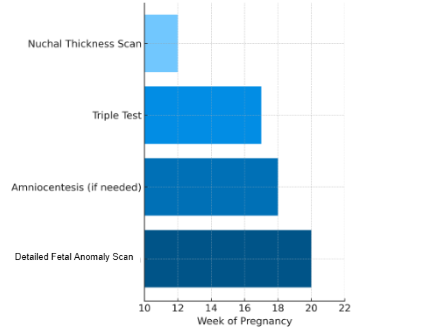 Chart showing timeline of key prenatal tests during pregnancy
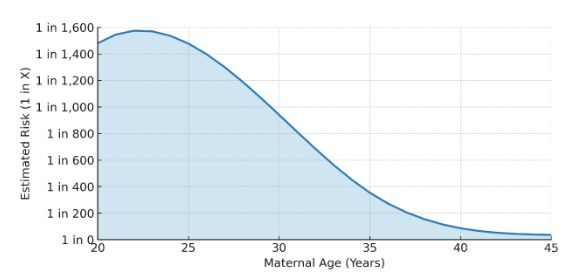 Chart showing risk of Down syndrome by maternal age (wald et al., 2003)
This test is often paired with a first-trimester blood test for a more accurate risk assessment. It is especially recommended for women undergoing IVF, as part of enhanced monitoring in early pregnancy.
Chart showing risk of Down syndrome by maternal age (wald et al., 2003)
This test is often paired with a first-trimester blood test for a more accurate risk assessment. It is especially recommended for women undergoing IVF, as part of enhanced monitoring in early pregnancy.
Why Prenatal Testing Matters
These antenatal screening tests are a standard part of obstetric care for all expectant mothers in Malaysia, regardless of how the pregnancy began. However, women who conceive through fertility treatments like IVF or IUI may benefit from closer monitoring, particularly in cases such as:- Maternal age above 35
- Previous miscarriage or genetic concerns
- Multiple pregnancy (e.g., twins)
- Desire for greater reassurance after fertility treatment
Chart showing timeline of key prenatal tests during pregnancy
1. Nuchal thickness scan (Week 11–14)
The nuchal translucency (NT) scan is an early non-invasive ultrasound test that measures the clear fluid space behind your baby’s neck. An increased measurement can indicate a higher risk of:- Down Syndrome (Trisomy 21)
- Edwards Syndrome (Trisomy 18)
- Patau Syndrome (Trisomy 13)
Chart showing risk of Down syndrome by maternal age (wald et al., 2003)
This test is often paired with a first-trimester blood test for a more accurate risk assessment. It is especially recommended for women undergoing IVF, as part of enhanced monitoring in early pregnancy.
2. NICC or NIPT Test (Week 15–20)
Also known as maternal serum screening, the triple test is a blood test that measures three important substances:- AFP (alpha-fetoprotein) – from the baby’s liver
- Estriol – a form of estrogen
- Beta-hCG – a pregnancy hormone
- Chromosomal abnormalities
- Neural tube defects, such as spina bifida
3. Amniocentesis (Week 15–20, if indicated)
Amniocentesis is an advanced diagnostic procedure where a small sample of amniotic fluid is collected using ultrasound-guided needle insertion. The fluid is tested for:- Genetic and chromosomal abnormalities
- Infections or metabolic disorders
- You’re over 35 years old
- Screening tests indicate elevated risk
- You have a family history of genetic disorders
4. Detailed Fetal Anomaly Scan (Around Week 20-24)
The detailed fetal anomaly scan, is a mid-pregnancy ultrasound that carefully examines your baby’s anatomy. This includes:- Brain, spine, heart, and abdominal organs
- Face, limbs, fingers, and toes
- Placenta location and amniotic fluid level
- Umbilical cord insertion
- Cleft lip and palate
- Heart defects
- Spina bifida – a birth defect where a baby’s spine and spinal cord don’t fully develop, causing potential nerve and mobility problems.
- Anencephaly – a severe birth defect where parts of a baby’s brain and skull are missing, leading to death shortly after birth.
- Detailed fetal anomaly scan can also detect certain physical abnormalities associated with trisomy.
| Condition | NT Scan | Triple Test | Amniocentesis | Detailed Scan |
|---|---|---|---|---|
| Down Syndrome (Trisomy 21) | ✓ | ✓ | ✓ | ✕ |
| Edwards/Patau Syndromes | ✓ | ✓ | ✓ | ✕ |
| Neural Tube Defects | ✕ | ✓ | ✓ | ✓ |
| Physical/Organ Abnormalities | ✕ | ✕ | ✕ | ✓ |
Table summarizing key prenatal scans and what they detect (Malone, 2005)
Summary of Key Prenatal Tests
| Test | Recommended Weeks | Purpose |
|---|---|---|
| Nuchal Thickness Scan | 11–14 weeks | Screens for chromosomal abnormalities (e.g., Down Syndrome) |
| Triple Test | 15–20 weeks | Estimates risk for neural tube and chromosomal conditions |
| Amniocentesis | 15–20 weeks (as needed) | Confirms genetic abnormalities (diagnostic test) |
| Detailed Scan | 20–24 weeks | Assess fetal anatomy and physical abnormalities |
Where to Get Prenatal Tests in Malaysia
If you’re expecting — especially after IUI, IVF, or at age 35+ — it’s wise to discuss these tests early in your pregnancy with a trusted healthcare provider. At Metro IVF, we provide:- Early pregnancy and viability scans
- Prenatal screening (NT, triple test, etc.)
- Detailed fetal anomaly scans
- Amniocentesis by experienced specialists
- Gentle, supportive counselling for all parents-to-be

