Table of Contents
Guide to Common Fertility and Genetic Tests at Metro IVF
Understanding Common Fertility and Genetic Tests
Planning a family can be both exciting and a little overwhelming—especially when you don’t know what tests you might need along the way. At Metro IVF, we believe understanding your reproductive health should be simple, supportive, and reassuring. Whether you’re starting to think about parenthood or already on your fertility journey, our clear approach will help you know exactly what tests are available, why they matter, and how we guide you through each one.
1. Initial Consultation
We begin with a relaxed conversation with our specialists—no medical jargon required. We’ll review your medical history (any existing conditions or medications), lifestyle (diet, stress, smoking or alcohol habits), and even your family planning goals.
- Gentle Physical Check & Basic Tests: Depending on your story, we may recommend simple blood tests (hormones, general health panels) and, for women, a routine pelvic ultrasound (to check your uterus and ovaries). For men, a quick semen analysis helps us understand sperm health (count, movement, shape).
Why do I need a Consultation?
By listening to your unique health background and looking at preliminary tests, we can pinpoint where to focus next saving you unnecessary steps, time, and stress.
2. Basic Male and Female Fertility Tests
Basic male and female fertility tests are simple and helpful check-ups that give you a clear picture of your reproductive health, making the journey to parenthood a little easier and more confident for both partners. Learn more about these tests at Comprehensive Fertility Test.
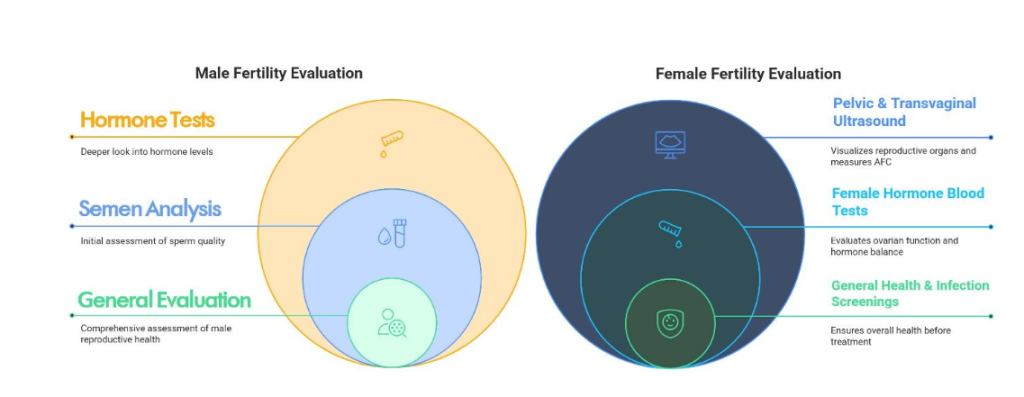
Male Fertility Evaluation
- Semen Analysis
- Quick & Easy: Collect a sample after 3–4 days without ejaculation. We analyze sperm count, movement (motility), and shape (morphology).
- Why It’s Helpful: Around 30–40% of fertility challenges relate to “male factors,” so checking sperm health early can guide our treatment plan.
- Male Hormone Tests (if needed)
- What We Look For: Testosterone and other androgens (male hormones). Abnormal levels can affect sperm production.
- When We Do It: If your semen analysis or medical history suggests a deeper look at hormone balance
Female Fertility Evaluation
- Pelvic & Transvaginal Ultrasound
- What You’ll Experience: A gentle ultrasound probe (transvaginal) gives us a close look at your uterus, ovaries, and lining.
- Key Info: We measure your Antral Follicle Count (AFC)—an estimate of how many eggs you might have—and check for fibroids, cysts, or scar tissue.
- Female Hormone Blood Tests
- Which Hormones? FSH, LH, estrogen, prolactin, thyroid hormones—and often AMH (Anti-Müllerian Hormone, see below).
- Why It’s Useful: Hormone levels help us understand how well your ovaries are working and if there are any imbalances affecting ovulation.
- General Health & Infection Screenings
- Routine Checks: Full blood count, liver/kidney function, plus screenings for HIV, Hepatitis B, and other infections.
- Peace of Mind: Ensuring overall health is essential before any reproductive treatment.
3. Key Tests & What They Tell You
Below are the most common (and some specialized) tests that play a major role in guiding fertility care. We’ve kept these explanations straightforward—and we’ll always adapt any test plan to your personal needs.
A. Anti-Müllerian Hormone (AMH) Test
- What It Is: A blood test that measures AMH—a hormone linked to the number of eggs remaining in your ovaries (your “ovarian reserve”).
- Why You Want It:
- Helps predict how you might respond to ovarian stimulation if you pursue IVF (in-vitro fertilization).
- Can hint at conditions like PCOS (Polycystic Ovary Syndrome) if levels are very high.
- Works anytime in your cycle—no need to wait for “day 3” of your period.
- Who Benefits: Anyone considering IVF, women delaying pregnancy, or those with known PCOS/endometriosis.
B. Hysterosalpingography (HSG): Fallopian Tubes Test
- HSG (X-ray Dye Test):
- A thin catheter gently places a safe dye into your uterus.
- An X-ray (fluoroscopy) watches the dye flow through your fallopian tubes—revealing any blockages or unusual shapes.
- Why These Matter:
- HSG (X-ray Dye Test):
- Blocked tubes are a common reason for infertility. Recognizing a blockage early means we can address it (e.g., surgery or direct IVF bypass).
- Who Should Consider These: Women with unexplained infertility, previous tubal infections, or history of pelvic surgery.
C. Diagnosing Polycystic Ovary Syndrome (PCOS)
- What PCOS Is: A hormonal imbalance where small, immature follicles (often mistaken for “cysts”) accumulate, disrupting normal ovulation.
- How We Diagnose: You’ll need at least two of these three:
- Irregular Periods: Fewer than eight cycles a year, missed periods, or very long cycles.
- Signs of High Male Hormones (Hyperandrogenism): Acne, unwanted facial/body hair, or scalp hair thinning—confirmed by a simple blood test.
- Ultrasound Findings: Ovaries appear enlarged with multiple tiny follicles around the edge.
- Common Symptoms: Irregular cycles, unpredictable bleeding, acne, weight gain, and sometimes trouble conceiving.
- Treatment Approach: Lifestyle changes (diet/exercise), medications to regulate periods or stimulate ovulation, and sometimes minimal procedures like ovarian drilling.
D. Endometrial Receptivity Analysis (ERA Test)
- Purpose: Finding your personal “Window of Implantation” (WOI)—the precise time when your uterine lining is most receptive to an embryo.
- Who Needs It: Women who have had two or more IVF cycles with good embryos but no pregnancy (Recurrent Implantation Failure).
- How It Works:
- We take a tiny biopsy of your uterine lining (endometrium) during a mock cycle (either natural or with hormones).
- That sample is analyzed for specific gene expression patterns (about 248 genes) to see if your lining is “pre-receptive,” “receptive,” or “post-receptive.”
- Using these results, we time your actual embryo transfer in a future IVF cycle for the moment when your uterus is most welcoming.
- Benefits:
- Increases the chance of successful implantation (studies show up to 70–75% first-cycle pregnancy rates with ERA in the right patients).
- Reduces emotional and financial stress by avoiding “trial-and-error” transfer timings.
E. Preimplantation Genetic Testing (PGT)
PGT is all about choosing the healthiest embryo before transfer—helping improve success rates and reduce miscarriage risk.
- PGT-A (for Aneuploidies)
- What It Screens: Abnormal number of chromosomes (e.g., Down syndrome [47 chromosomes instead of 46], Turner syndrome, etc.).
- Who Typically Uses It:
- Women aged 35 and above (egg quality declines with age).
- Couples with prior IVF failures or recurrent miscarriages.
- How It Works: On Day 5–6 of embryo development (blastocyst stage), we carefully biopsy a few cells, send them for chromosome counting, and only transfer embryos with a normal chromosome count.
- Why It Matters: Significantly lowers miscarriage rates and increases chances for a healthy, full-term pregnancy.
- PGT-SR (for Structural Rearrangements)
- What It Screens: Chromosomal rearrangements (deletions, duplications, translocations, inversions) in individuals known to carry these balanced changes.
- Who Needs It: Those with a family history of genetic rearrangements (e.g., a parent with a balanced translocation) who risk passing on an unbalanced version.
- Benefits: Identifies embryos with the correct amount of genetic material—minimizing miscarriage risk and preventing an affected child.
- PGT-M (for Monogenic Diseases)
- What It Screens: Single-gene (Mendelian) disorders—e.g., Thalassemia or Duchenne muscular dystrophy—if you know you’re a carrier.
- Impact: Avoids passing on serious inherited diseases by selecting embryos without the specific gene mutation.
Note: PGT is not about diagnosing you—it’s about evaluating each embryo. If you need genetic carrier screening (blood test), we also offer that, but the PGT process happens after IVF’s egg retrieval and fertilization stages.
- PGT-A (for Aneuploidies)
F. Non-Invasive Prenatal Testing (NIPT)
- When It’s Done: After you’re pregnant—as early as 12–14 weeks gestation.
- What It Looks For: Fetal chromosomal abnormalities (trisomy 21, 18, 13; sex chromosome issues like Turner [XO] or Klinefelter [XXY]).
- How It Works: A simple blood draw from mom checks cell-free DNA from the placenta (fetal DNA floats in mom’s bloodstream).
- Who Should Consider NIPT:
- Expectant moms age 35 or older (higher risk for chromosomal differences).
- Those with positive early screening results (e.g., combined first-trimester screen).
- Anyone with a personal/family history of genetic conditions.
- Why It’s Called “Screening” (Not Diagnosis): A positive NIPT result means an increased chance of an abnormality—it’s not definitive. Any positive result must be confirmed via diagnostic methods (amniocentesis or chorionic villus sampling).
Benefit: Provides early reassurance (or early awareness), with no risk of harming the baby.
To make things easier and clearer, we’ve gathered all this information in the handy table below
| Test Name | Primary Objective | Key Procedure | Main Indications/Who Benefits | Relevance |
|---|---|---|---|---|
| AMH Test | Assess ovarian reserve (egg quantity) and predict ovarian response to IVF stimulation | Simple blood test, can be done any time in cycle | Women experiencing difficulties conceiving, considering delayed childbearing, exploring IVF, or with PCOS/endometriosis | Pre-conception fertility assessment, IVF planning |
| HSG Test | Check fallopian tube patency and uterine cavity abnormalities | X-ray with contrast dye injected into uterus | Infertility, suspected tubal blockage, recurrent miscarriage | Pre-conception fertility assessment |
| ERA Test IVF | Determine optimal Window of Implantation (WOI) for personalized embryo transfer | Endometrial biopsy and gene expression analysis (NGS) | Patients with Recurrent Implantation Failure (RIF) (≥2 failed IVF cycles despite good embryos) | During IVF cycle, optimizing embryo transfer |
| PGT-A | Screen embryos for numerical chromosomal abnormalities (aneuploidy) | Embryo biopsy (Day 5/6 blastocyst) & genetic analysis | Advanced maternal age (>35), recurrent IVF failures, recurrent miscarriage, couples seeking improved IVF outcomes | During IVF cycle, embryo selection |
| PGT-SR | Screen embryos for chromosomal structural rearrangements | Embryo biopsy (Day 5/6 blastocyst) & genetic analysis | Individuals who are carriers of balanced chromosomal rearrangements (e.g., translocations, inversions) | During IVF cycle, embryo selection |
| NIPT Test | Screen for common fetal chromosomal abnormalities during pregnancy | Maternal blood sample & cell-free fetal DNA analysis | Pregnant women aged 35+, positive results from other prenatal screens, history of chromosomal abnormalities, known genetic conditions | Prenatal screening (post-conception) |
4. Why Choose Metro IVF for Your Testing & Care?
At Metro IVF, we put you first—listening closely, explaining every test in plain language, and ensuring you feel comfortable throughout your fertility journey. Our clinic offers everything under one roof—from friendly consultations, ultrasounds, and blood draws to genetic counseling and full IVF protocols—while our expert team uses cutting-edge technology like ERA, and advanced PGT for the best possible outcomes. We strictly follow Malaysian Medical Council and MOH guidelines to guarantee your informed consent, confidentiality, and dignified care at every step.
Remember, you’re never alone—our friendly nurses, counselors, and doctors are here to answer questions, ease anxieties, and celebrate wins (big and small) together.
Start Your Journey Today
Take the first step towards parenthood with confidence. Contact Metro IVF to schedule a consultation and explore our fertility testing options tailored to your needs.
