Nuchal Translucency (NT) Scan in Malaysia: A Simple Guide for Expecting Parents
The Nuchal Translucency (NT) Scan is an important first-trimester ultrasound performed between 11 and 13 weeks 6 days of pregnancy. It is a safe, non-invasive way to assess your baby’s early development and screen for conditions such as Down syndrome, Trisomy 18, Trisomy 13. Many parents choose the NT scan because it offers early reassurance and helps plan the rest of the pregnancy.
What is an NT Scan?
The NT scan measures the clear fluid space at the back of your baby’s neck. A thicker measurement may indicate a higher chance of chromosomal abnormalities or structural issues.
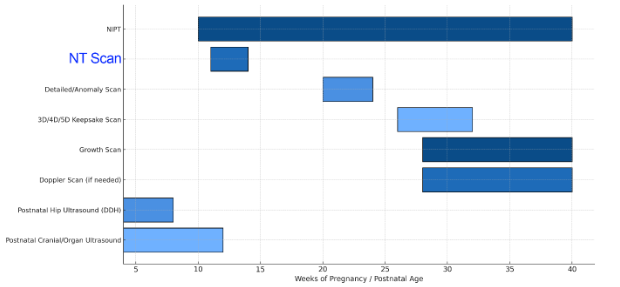
Timeline chart showing the recommended prenatal and postnatal ultrasound examinations, showing when key scans—including NT screening, anomaly scans, growth monitoring, Doppler studies, and postnatal hip or cranial ultrasounds—are typically performed to support safe, structured pregnancy care (American College of Obstetricians and Gynaecologists 2023; Ministry of Health Malaysia 2025).
During the scan, your doctor will also:
- Confirm the gestational age using Crown-Rump Length (CRL)
- Check the heartbeat and early fetal development
- Look for early structural abnormalities
- Assess the nasal bone, which improves screening accuracy
The scan takes about 15–20 minutes and is completely painless.
When Should You Do the NT Scan?
The NT scan is only accurate when performed:
- Between 11 weeks 0 days and 13 weeks 6 days
- When the baby measures CRL 45–84 mm
Performing the scan outside this range makes the results invalid, so timely appointments are essential.
Combined First Trimester Screening (cFTS)
For best accuracy, many clinics combine the NT scan with blood tests and maternal-age assessment. This is known as Combined First Trimester Screening (cFTS).
It includes:
- NT measurement
- Nasal bone assessment
- Blood tests (PAPP-A and free β-hCG)
- Maternal age and clinical risk factors
This combination provides a 90–95% detection rate for Down syndrome. Results classify pregnancies as low-risk or high-risk, but do not confirm a diagnosis.
If Your NT Scan Shows a High-Risk Result
A high-risk result means you may need additional screening.
Non-Invasive Prenatal Testing (NIPT)
- A maternal blood test
- More than 99% accuracy for common aneuploidies
- No risk to the baby
- Results in 7–10 working days
NIPT often avoids the need for invasive procedures.
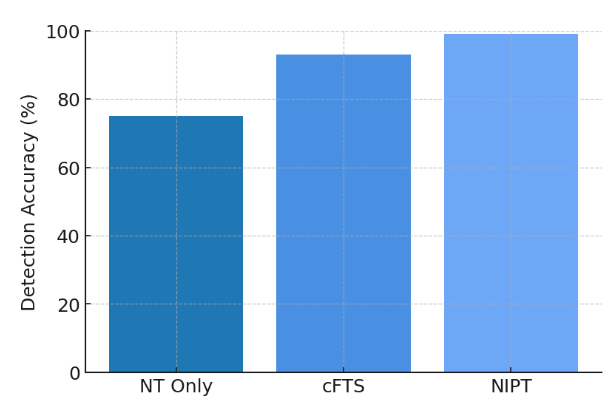
Bar charts showing that screening accuracy improves when NT measurement is combined with maternal serum markers (cFTS), while NIPT remains the most accurate non-invasive option (Gil et al. 2015).
Diagnostic Tests
If a confirmed diagnosis is needed, your doctor may discuss:
- Chorionic Villous Sampling (CVS)
- Amniocentesis
These tests provide near-100% accuracy but carry a small miscarriage risk (0.5–1%). Your doctor will guide you based on your circumstances and preferences.
Why the NT Scan Still Matters
Even when genetic testing is not pursued, the NT scan remains valuable because it also screens for:
- Early structural abnormalities
- Growth or dating concerns
- Fetal viability and heartbeat
This information supports safer pregnancy planning and early referral when needed.
Private Hospitals
- Above RM150
- Flexible appointment scheduling
- Access to trained sonographers and MFM specialist with structured screening packages.
Because the NT scan must be done within a strict timeframe, many parents choose private clinics for convenience and accuracy.
Cultural and Ethical Considerations
Malaysia’s multicultural population has varied beliefs about prenatal testing and pregnancy decisions. For this reason, national policy encourages NT screening as an optional, parent-driven choice.
Metro IVF provides:
- Clear, unbiased explanation of results
- Guidance on next steps
- Respect for each family’s values, beliefs, and decisions
The focus is on helping parents prepare, understand their options, and make informed choices.

