How Time-Lapse Embryo Monitoring Helps Doctors Choose the Best Embryo
Choosing the best embryo is one of the most important steps in in vitro fertilisation (IVF). Time-lapse embryo monitoring is a modern IVF laboratory technology designed to help embryologists select embryos more carefully, while keeping them in a stable and undisturbed environment throughout early development.
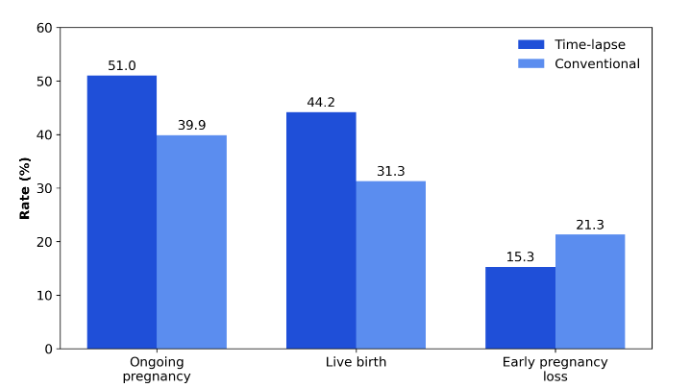
Bar charts showing meta-analyses results linking time-lapse embryo monitoring to higher pregnancy and live birth rates, and fewer early pregnancy losses in some cases (Pribenszky et a., 2017).
This approach is increasingly used in advanced fertility centres, including Metro IVF, to support safer embryo culture and more informed embryo selection.
What is time-lapse embryo monitoring?
Time-lapse embryo monitoring uses a special incubator with an integrated camera and microscope. Instead of removing embryos from the incubator once or twice a day for manual checks, the system automatically takes images every few minutes while embryos remain inside.
These images are combined into a continuous visual record showing how each embryo develops from fertilisation to the blastocyst stage.
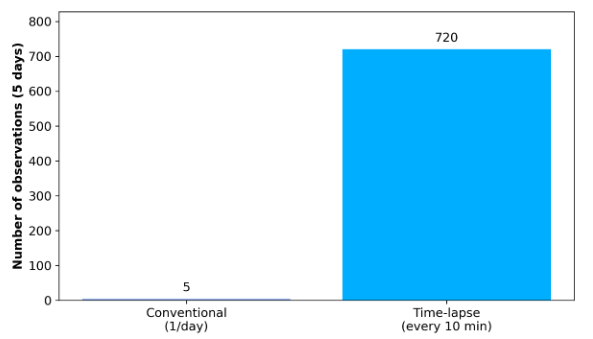
Time-lapse systems can capture embryo images every 10 minutes, creating thousands of data points across a culture period—compared with a small number of once-daily “snapshot” checks in conventional monitoring (Vitrolife, 2024).
How is it different from conventional embryo checks?
In conventional IVF, embryos are periodically taken out of the incubator to be examined under a microscope. Each removal briefly exposes them to changes in temperature, oxygen levels, and pH.
With time-lapse monitoring:
- Embryos stay in a stable, controlled environment
- Development is observed continuously rather than at fixed time points
- Embryologists can assess both embryo appearance and developmental timing
This allows embryo selection to be based on how an embryo grows, not just how it looks at a single moment.
Table comparing time-lapse embryo monitoring against conventional embryo monitoring, highlighting how embryos are observed, handled, selected, and the practical differences in cost and clinical use for IVF patients.
Feature | Time-Lapse Monitoring (TLM) | Conventional Monitoring (CM) |
|---|---|---|
How embryos are checked | Automatically photographed every few minutes | Checked once a day by removing them from the incubator |
Embryo handling | Embryos stay inside the incubator the whole time | Embryos are taken out briefly for inspection |
Stability of conditions | Very stable (no disturbance) | Small temperature and pH changes may occur |
How embryos are chosen | Based on growth patterns over time (often with computer help) | Based on how embryos look at one point in time |
What can be seen | Can detect short-lasting problems in development | May miss changes that happen between daily checks |
Lab workflow | Embryologists can review images anytime | Requires hands-on checks at set times |
Proven benefit | Helpful for monitoring, but not proven to improve birth rates for everyone | Long-established and widely trusted method |
Cost to patients | Usually an extra paid option | Usually included in standard IVF fees |
Why does embryo development timing matter?
Healthy embryo development follows a steady and well-coordinated rhythm. Research shows that embryos which divide at the right pace and in a symmetrical pattern are more likely to implant successfully.
Time-lapse systems allow embryologists to:
- Observe the exact timing of cell divisions
- Identify embryos that develop smoothly and consistently
- Detect short-lived abnormalities that may be missed with once-daily checks
An embryo may appear normal on a routine check but still have hidden developmental issues that reduce its chance of implantation.
How does time-lapse monitoring help embryo selection?
Time-lapse embryo monitoring provides detailed developmental information that supports more precise embryo ranking. This is especially useful when planning single embryo transfer, where selecting the best embryo is critical for maximising pregnancy chances while reducing the risk of multiple pregnancies.
By combining visual appearance with developmental timing, embryologists can make more informed and objective decisions.
The role of artificial intelligence (AI) in time-lapse IVF
Many time-lapse systems use artificial intelligence (AI) to analyse embryo development patterns. These AI tools compare an embryo’s growth timeline with large datasets of embryos that resulted in successful pregnancies.
AI-assisted embryo scoring:
- Improves consistency in embryo assessment
- Reduces differences between individual embryologists
- Supports clinical decision-making rather than replacing it
AI does not guarantee pregnancy, but it provides an additional data-driven layer of support.
Is time-lapse embryo monitoring safe?
Yes. Time-lapse monitoring is:
- Non-invasive
- Designed to minimise light exposure
- Performed without touching or moving the embryos
Because embryos remain undisturbed inside the incubator, this method is considered one of the most embryo-friendly approaches available in modern IVF laboratories.
Does time-lapse monitoring improve IVF success rates?
Scientific studies show mixed results when looking at overall pregnancy and live birth rates across all IVF patients. However, evidence suggests that time-lapse monitoring may be particularly beneficial for:
- Patients with repeated failed embryo transfers
- Women of advanced maternal age
- Cycles with a limited number of embryos
- Donor egg IVF cycles
Even when success rates are similar, time-lapse monitoring improves laboratory conditions, reduces handling-related stress on embryos, and enhances confidence in embryo selection.
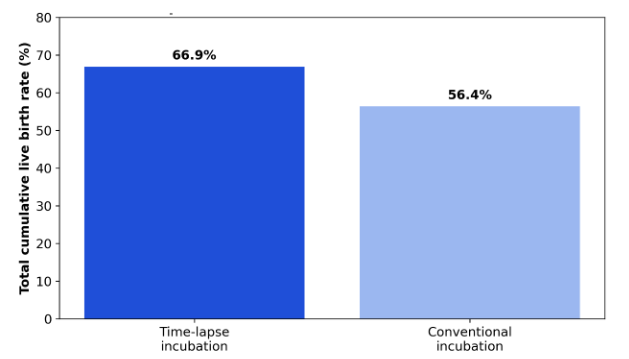
Couples whose embryos were cultured using time-lapse incubators had a higher overall chance of achieving a live birth across fresh and frozen embryo transfers, compared with conventional incubation (Reignier et al., 2021).
Why is time-lapse monitoring sometimes an add-on cost?
Time-lapse technology involves advanced incubators, specialised culture dishes, software systems, and trained laboratory staff. For this reason, some clinics include it within IVF packages, while others offer it as an optional service.
Your fertility specialist can explain how time-lapse monitoring fits into your individual treatment plan.

