Pregnancy Scan (Detailed Fetal Anomaly Scan) in Malaysia
The Fetal Anomaly Scan (FAS)—also known as the Detailed Scan, Level II scan, or 20-week ultrasound—is one of the most important pregnancy scans. This mid-trimester examination gives expecting parents a detailed look at their baby’s development, using medical ultrasound to screen for structural abnormalities and assess overall fetal health.
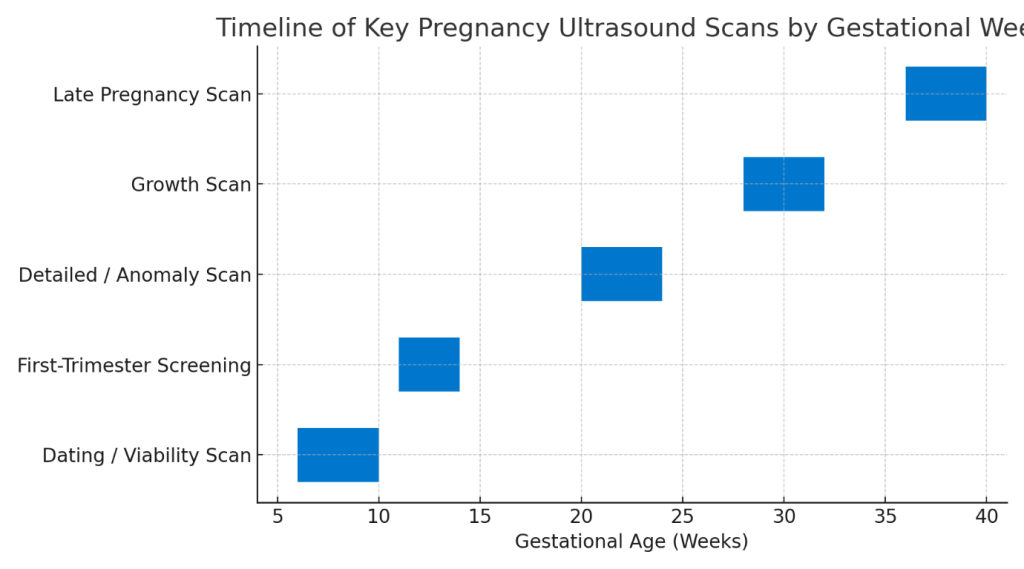
Timeline showing key pregnancy ultrasounds and their diagnostic importance, highlighting the significance of the 20–24 weeks anomaly scan (MOH Malaysia 2025).
In Malaysia, the anomaly scan is typically done around 20–24 weeks and is considered a key part of safe, high-quality prenatal care. This guide explains what the scan checks, why it matters, how it is done, and what parents should know before choosing a clinic.
What Is a Fetal Anomaly Scan and When Should It Be Done?
A Fetal Anomaly Scan is an in-depth medical ultrasound that examines your baby’s organs, limbs, face, spine, and overall anatomy. Unlike earlier scans that confirm pregnancy or estimate due dates, this is a structural scan done in the middle of pregnancy.
Best time to do the anomaly scan: 20–24 weeks
This gestational window is chosen because:
- The baby’s organs are well-developed and can be examined clearly
- There is enough amniotic fluid for good imaging
- Problems detected at this stage allow time for planning and intervention
Although many clinics offer 3D, 4D, and 5D imaging, the evaluation of FAS scan is based on 2D ultrasound, which provides the most detailed view of internal organs.
What Does the FAS Scan Check?
The scan follows a standardized, globally accepted checklist. It is designed to detect structural physical abnormality and also to confirm that important organs are developing normally.
A. Growth and Biometry
The scan measures:
- Biparietal Diameter (BPD) – width of the baby’s head
- Head Circumference (HC)
- Abdominal Circumference (AC)
- Femur Length (FL)
These measurements help estimate fetal weight and ensure your baby is growing well.
B. Baby’s Organs and Anatomy
Brain & Spine:
Screens for spina bifida, hydrocephalus, anencephaly, abnormal skull formation, and brain structures.
Heart:
The MFM specialist or sonographer checks the four chambers and major arteries. Many congenital heart defects can be detected during this scan. *must highlight MFM specialist before sonographer*
Abdomen:
Confirms stomach, kidneys, bladder, diaphragm, and abdominal wall surrounding.
Face & Limbs: Checks for cleft lip/palate, missing limbs, clubfoot, skeletal dysplasia.
C. Placenta, Amniotic Fluid, and Maternal Risks
The anomaly scan also evaluates:
- Placenta location (placenta previa, low-lying placenta)
- Amniotic fluid volume
- Umbilical cord anatomy
- Umbilical artery Doppler
- Uterine artery Doppler, which screens for preeclampsia risk
This makes the scan useful not only for the baby, but also for monitoring maternal health.
Why Is the FAS So Important?
A. Early detection improves pregnancy outcomes
If a structural issue is found, doctors can:
- Arrange delivery at a hospital with NICU facilities
- Plan necessary surgery or treatment immediately after birth
- Monitor the pregnancy more closely
Preparation can significantly improve newborn survival and long-term health.
B. Most parents get reassurance
For many families, the detailed scan can see through the ongoing development of the baby—bringing peace of mind during a crucial stage of pregnancy.
C. Helps identify maternal complications
The scan can show risk factors like:
- Preeclampsia
- Fetal growth restriction
- Placental insufficiency
Early intervention reduces risks for both mother and baby.
Limitations of the FAS scan
While the anomaly scan is extremely valuable, no pregnancy scan can detect all conditions.
A. It is a structural—not genetic—screening (must highlight this sentence).
It may miss:
- Chromosomal abnormalities
- Metabolic disorders
- Conditions that only appear after birth
B. Results may be uncertain
Challenges that can affect accuracy include:
- Baby’s position
- Low amniotic fluid
- Maternal body composition/habitus
- Operator experience
- Equipment quality
C. Emotional impact can be significant
Malaysian studies show that unexpected abnormal findings can cause high stress and anxiety in the first two weeks after diagnosis.
Professional counselling makes a major difference for parents receiving difficult news.
How Much Does an Anomaly Scan Cost in Malaysia?
Pricing varies depending on facility and expertise:
Healthcare Setting | Typical Cost (RM) | What You Get |
|---|---|---|
Government Hospitals | ~RM200-300 | Affordable, longer waiting times |
Private Specialist Clinics/MFM Specialists | Above RM 400-RM600 | With faster appointments, specialist scan and review |
Important:
3D/4D/5D ultrasound does not improve diagnostic accuracy—they enhance images for bonding.
The core medical evaluation is always done using 2D ultrasound.
What Happens If the Scan Finds Something?
If a concern is detected, your care team may recommend:
A. Additional imaging
- Fetal echocardiogram
- Fetal MRI (for brain and complex conditions)
B. Genetic testing
- Amniocentesis (15–20+ weeks)
- Chorionic Villus Sampling (CVS)
These tests can confirm or rule out chromosomal or genetic abnormalities.
C. Professional counselling
Genetic counselling is essential for helping parents understand:
- Diagnosis
- Treatment options
- Prognosis
- Next steps for pregnancy care
Malaysia has established genetic centres, though availability varies across regions.

