Preimplantation Genetic Testing (PGT) in Malaysia

Table of Contents

Preimplantation Genetic Testing (PGT) in Malaysia

A Smarter Way to Improve IVF Success

At Metro IVF Malaysia, we believe every step in your fertility journey should bring clarity, confidence, and hope.
That’s why we offer Preimplantation Genetic Testing (PGT) — an advanced form of embryo screening that helps you and your partner make informed decisions during your IVF treatment.
By identifying the healthiest embryos before transfer, PGT can boost your IVF success rate and improve the chance of bringing home a healthy baby.
 

At Metro IVF Malaysia, we believe every step in your fertility journey should bring clarity, confidence, and hope.
That’s why we offer Preimplantation Genetic Testing (PGT) — an advanced form of embryo screening that helps you and your partner make informed decisions during your IVF treatment.
By identifying the healthiest embryos before transfer, PGT can boost your IVF success rate and improve the chance of bringing home a healthy baby.

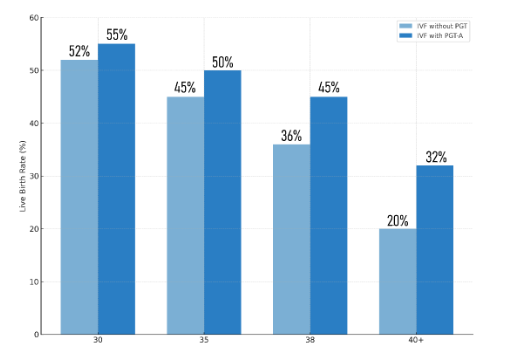
Chart showing higher live birth and lower miscarriage rates with PGT-A compared to standard IVF. Data adapted from ASRM Committee (2024).

What is Preimplantation Genetic Testing (PGT)?

In simple terms, PGT is a genetic screening test performed during the IVF process.
After eggs are retrieved and fertilised, embryos are cultured in the lab for a few days. Before they are transferred into the uterus, PGT is used to check each embryo’s genetic and chromosomal health.

Flowchart showing where PGT tests are involved, if opted.

Flowchart showing where PGT tests are involved, if opted.

This matters because chromosomal abnormalities are one of the main causes of failed implantation, miscarriage, and unsuccessful IVF cycles.


By screening embryos early, couples can avoid transferring embryos that are unlikely to develop successfully.

Why PGT matters in IVF

PGT gives you more control, confidence, and clarity in your fertility journey:

      • For women aged 38 and above: The risk of chromosomal abnormalities increases with age. PGT provides reassurance by identifying embryos with the correct number of chromosomes.
      • For couples with recurrent miscarriage or failed transfers: PGT helps identify embryos most likely to implant and grow into a healthy pregnancy.
      • For families with genetic conditions: PGT screens for inherited single-gene disorders and chromosomal rearrangements, reducing the risk of passing them on.
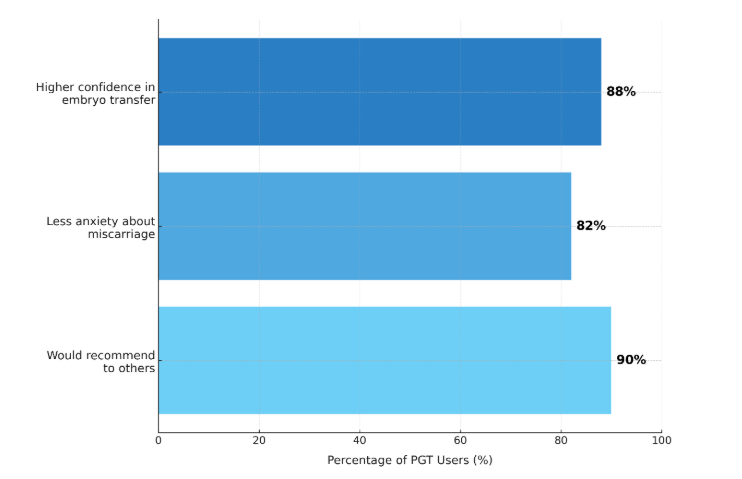
Chart showing patient sentiment after using PGT. Data adopted from Human Reproduction Update (2020), Fertility and Sterility (2019), ASRM (2024)

In short, PGT helps you focus on the embryos that have the best chance — reducing uncertainty, emotional strain, and time to success.

The Metro IVF advantage: Precision and care combined

At Metro IVF, we use only the most advanced methods in reproductive genetics.

      • Blastocyst biopsy (Day 5–6): We take a few cells from the outer layer of the embryo, not the part that forms the baby, ensuring accuracy and safety.
      • Next-Generation Sequencing (NGS): This gold-standard technology analyses all 24 chromosomes with exceptional precision, helping identify even small chromosomal imbalances.

This modern approach means more accurate results, faster decisions, and fewer wasted IVF cycles — giving you a clear path toward pregnancy.

Types of Preimplantation Genetic Testing

Type of PGT Purpose Who It’s For
PGT-A (Aneuploidy Screening) Checks whether embryos have the correct number of chromosomes. Women ≥ 38 years, couples with repeated miscarriages or failed implantations.
PGT-M (Monogenic Disorder Testing) Detects single-gene disorders such as cystic fibrosis, sickle-cell anaemia, or Huntington’s disease. Couples carrying known inherited conditions.
PGT-SR (Structural Rearrangement Testing) Finds chromosomal translocations, deletions, or duplications. Couples with a family history of chromosomal rearrangements.

How PGT improves the IVF journey

Faster Results, Fewer Disappointments

By selecting genetically “stronger” embryos, PGT reduces the risk of failed transfers or early miscarriage, helping you move forward with confidence.

Better Value Over Time

Although PGT adds to the initial IVF cost, it can save you from multiple unsuccessful cycles, lowering emotional and financial stress over time.

Safer Single-Embryo Transfer

Because PGT helps identify the most viable embryo, you may safely opt for single-embryo transfer, reducing the risks linked to twin or multiple pregnancies.

Peace of Mind

For high-risk patients — whether due to age, genetics, or past IVF losses — PGT offers reassurance and emotional relief during an often-stressful process.

Benefits of PGT in IVF

      • Improves IVF pregnancy and live-birth rates
      • Reduces miscarriage risk by selecting chromosomally normal embryos
      • Enables single-embryo transfer and reduces twin pregnancy risk
      • Minimises failed IVF cycles and emotional strain

Limitations to Consider

      • PGT does not guarantee a 100 percent healthy baby
      • It may slightly reduce the number of embryos available for transfer
      • Adds additional cost to IVF treatment
      • Some uncertainty remains with mosaic embryos (mixed normal and abnormal cells)

Why choose Metro IVF Malaysia for PGT

      • State-of-the-art technology: Blastocyst biopsy and NGS for the highest accuracy
      • Personalised genetic counselling: Clear explanations of what PGT can and cannot detect
      • Tailored care: Every plan is based on your age, past IVF results, and genetic background

Comprehensive support: From egg retrieval to embryo culture, testing, transfer, and follow-up — all within one trusted fertility centre

Frequently Asked Questions about PGT

No, PGT is not compulsory. It’s an optional add-on test offered during IVF to check the genetic health of embryos. Your doctor may recommend it if you’re older, have had previous miscarriages, or carry known genetic conditions — but it’s entirely your choice.

PGT in Malaysia generally costs around RM8,000 – RM15,000 per cycle, depending on how many embryos are tested and the type of PGT used.
When combined with a standard IVF cycle (around RM15,000 – RM25,000), the total package may range from RM25,000 – RM40,000+.

Couples with repeated IVF failures, miscarriages, advanced maternal age (≥ 38), or known genetic conditions.

Not completely. It reduces the risk of major chromosomal or genetic problems but cannot detect every condition.

PGT-A (chromosome count), PGT-M (single-gene disease), and PGT-SR (chromosomal rearrangements).

Pros: Higher pregnancy success, fewer miscarriages, safer single transfers.
Cons: Additional cost, minor risk of embryo damage, and not all embryos can be tested.

Yes. It helps identify healthy embryos, leading to faster success and lower miscarriage rates.

PGT adds several thousand ringgit to each IVF cycle, depending on the number of embryos tested. It may extend the process by about one to two weeks for lab analysis.

No. In Malaysia, PGT can only be used for medical and fertility reasons, not for gender preference.

Final word

If you’re planning IVF and want greater assurance of success, PGT is a smart and proactive step — especially for couples in higher-risk groups or with a history of IVF challenges.

At Metro IVF, we combine compassionate fertility care with the precision of advanced reproductive genetics. Our goal is to help you move forward with knowledge, confidence, and the highest standard of care.

Because you deserve the best technology and the best support for your journey to parenthood. Contact us today to speak with our caring team and take the next confident step into parenthood.

Start Your Journey Today

Take the first step towards parenthood with confidence. Contact Metro IVF to schedule a consultation and explore our fertility testing options tailored to your needs.