Table of Contents
Breast Cancer Screening Malaysia: Key Facts for Women & IVF Patients
Why breast cancer awareness is so important
Breast cancer is the most common cancer among Malaysian women. About 1 in 19 to 1 in 9 women here will develop it during their lifetime. The good news? If caught early, breast cancer has over a 90% survival rate. The challenge? Almost half of cases are diagnosed late, when treatment is harder and survival drops sharply.
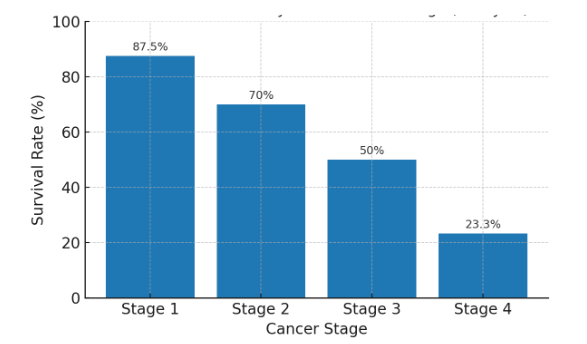
Chart showing 5-year survival rates by breast cancer stage in Malaysia (National Cancer Registry Malaysia, 2023)
The earlier we detect it, the simpler the treatment, the better the recovery, and the higher the chance of living a full, healthy life.
How to check for breast cancer ?
Screening is about finding problems before symptoms appear. In Malaysia, the main ways include:
- Breast Self-Examination (BSE)
- Do it once a month, 3–5 days after your period ends.
- Look for lumps, skin changes, or unusual discharge.
- Remember: most lumps are NOT cancer but always get them checked.
- Clinical Breast Examination (CBE)
- A doctor or nurse checks your breasts for lumps or changes.
- Every 3 years from age 20–39, yearly from age 35–40 onwards.
- Mammogram
- Low-dose X-ray of the breast used to detect breast cancer and other breast conditions.
- For women 40–49: consider yearly from age 40, or even earlier if high risk upon discussion with your doctor.
- For women 50–74: every 2 years.
- Other Tools (if needed)
- Ultrasound (for dense breast tissue or younger women)
- MRI (for high-risk women, e.g., family history, BRCA mutation)
- Genetic testing (for inherited risk)
| Age Group / Risk Level | Breast Self-Examination (BSE) | Clinical Breast Examination (CBE) | Mammogram | MRI / Genetic Testing |
|---|---|---|---|---|
| 20–39 years | Monthly | Every 3 years | Not routinely recommended | Not routinely recommended |
| 35–49 years | Monthly | Yearly | Not routinely recommended (except high-risk) | Not routinely recommended |
| 40–49 years | Monthly | Yearly | Annual (after doctor consultation) | Not routinely recommended |
| 50–74 years | Monthly | Yearly | Every 2 years | Not routinely recommended |
| High-risk (any age) | Monthly | Yearly | Annual | Annual (if BRCA+ or as advised by doctor) |
Notes:
• BSE = Self-check for lumps, skin changes, or unusual nipple discharge.
• CBE = Professional check by a doctor or nurse.
• High-risk includes strong family history or known BRCA1/BRCA2 mutation.
• Screening may start earlier for very high-risk individuals based on doctor’s advice.
Table showing the general breast screening recommendations by age group and risk level for women in Malaysia (Ministry of Health Malaysia, 2019)
Why breast screening matters for ART/IVF and pregnancy
If you’re planning fertility treatments like IVF, pregnant, or recently given birth, breast health becomes even more important:
- Before ART/IVF – Fertility treatments involve hormonal changes that can affect breast tissue. Screening ensures any breast issue is caught early before starting treatment.
- During pregnancy – Breast cancer can occur in pregnancy (though rare). Early detection means treatment can be planned without unnecessarily affecting your pregnancy.
- After birth – Some treatments may affect milk supply or breastfeeding ability. Screening helps guide safe feeding choices and protects both mother and baby’s health.
Your next step – Take charge of your breast health
- Do your monthly self-checks.
- Follow the recommended screening schedule.
- Seek professional help immediately for any changes.
At Metro IVF, we offer comprehensive breast cancer screening as part of your women’s health care.
Our team understands the unique needs of women planning a family, undergoing fertility treatments, or navigating pregnancy and post-partum life. We’re here to support you every step of the way – because your health is the first step towards your dreams.
