Table of Contents
Guide to in vitro Fertilization (IVF) in Malaysia
What it is and How to Get Help
In vitro fertilization (IVF) is a medical technique that helps individuals or couples have a baby when natural conception is difficult. It works by combining a woman’s egg and a man’s sperm in a lab—outside the body—to create an embryo, which is then placed into the woman’s womb to grow into a pregnancy. It’s in our name: at Metro IVF, we combine advanced fertility technology, experience and compassionate care to help you start your journey to parenthood with confidence and support.
Why Choose IVF?
For many couples, the journey to parenthood can be filled with unexpected challenges. IVF offers a reliable solution by combining eggs and sperm in a controlled laboratory setting- it’s hope transformed into action. This method:
- Bypasses Blockages: When fallopian tubes are blocked or damaged, natural fertilization is impossible. IVF routes around these issues entirely.
- Overcomes Male Factors: Low sperm count or motility? Techniques like ICSI (injecting a single sperm into each egg) help ensure fertilization.
- Addresses Unexplained Infertility: Even if standard tests don’t reveal a problem, IVF can succeed by giving embryos the best possible start.
- Works for Older Women: Since egg quality and quantity decline with age, IVF—with advanced embryo screening—boosts the chance of success for women over 35.
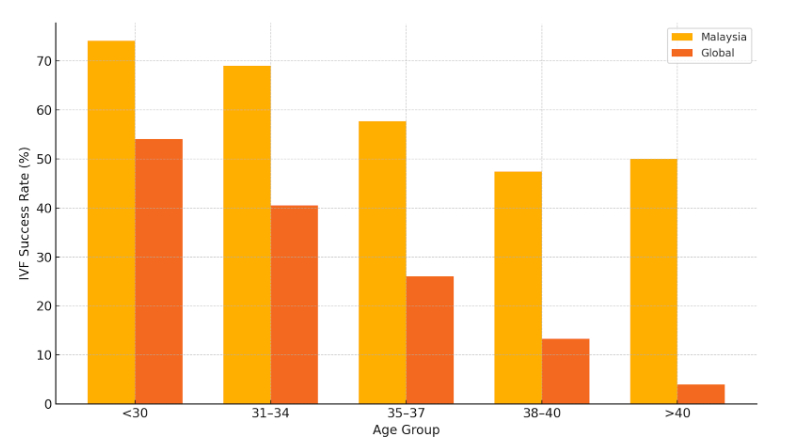
IVF success rates by age group: a comparison between Malaysia and Global trends (Neighmond 2009, SART 2019)
What is the IVF Process?
The IVF process consists of four main stages which are explained below. Throughout each step, you’ll be supported by caring professionals who offer clear explanations and gentle encouragement every step of the way.

An overview of an IVF process
- Preparation and Ovary Stimulation
- Hormone Injections: Over about 8–12 days, daily shots help your ovaries produce multiple mature eggs (rather than the single egg in a natural cycle).
- Monitoring: Regular ultrasounds and blood tests track your response, so doctors can adjust dosages for optimal egg development.
- Emotional Check-Ins: Nurses and counselors are on hand to answer questions and ease any worries about injections or side effects.
- Egg Retrieval and Sperm Collection
- Egg Retrieval: Under light sedation, a thin needle guided by ultrasound gently collects your eggs. This quick procedure takes around 15–30 minutes, with minimal discomfort and a short recovery period.
- Sperm Sample: Your partner provides a sample on the same day.
- Fertilization and Embryo Culture
- Conventional Fertilization: Eggs and sperm are mixed in a petri dish.
- ICSI. For male-factor infertility, a single sperm is injected directly into each egg, boosting fertilization rates.
- Embryo Monitoring: Over 3–5 days, embryologists watch cell divisions closely, selecting the strongest embryos for transfer. Some clinics even use time-lapse imaging and AI to pick the best candidates.
- Embryo Transfer and Pregnancy Test
- Transfer Procedure: A soft catheter places your chosen embryo(s) into the uterus—no incision required. This quick, outpatient step is generally painless, and you can return home afterward.
The Two-Week Wait: About 10–14 days later, a simple blood test confirms whether implantation has occurred. During this period, your care team remains available for support and guidance.
Why Consider IVF in Malaysia?
Choosing Malaysia for your IVF journey means accessing cutting-edge care at competitive prices:
- World-Class Clinics: Facilities in Kuala Lumpur, Penang, Perak and Johor Bahru across the Malay Peninsular meet international accreditation standards.
- Expert Teams: Specialists trained abroad bring the latest protocols home, ensuring benefits from global best practices.
- High Success Rates: Up to 75% pregnancy rates in younger women, thanks to advanced lab techniques and personalized treatment plans.
- Medical Tourism Hub: English-speaking staff, streamlined visa processes, and patient coordinators make international travel smooth and stress-free.
Cost of IVF Treatment in Malaysia
In Malaysia, IVF is often regarded as more affordable compared to many other countries in the region, yet it still represents a significant financial commitment.
- Average Cost per Cycle:
A typical IVF cycle in Malaysia costs between RM14,000 and RM16,000, with premium clinics charging up to RM18,000. When converted to USD, this ranges from approximately $5,000 to $8,000 per cycle. The final cost depends on several factors, including the woman’s age, the clinic selected, the complexity of the treatment plan, and any additional services required.
- Average Cost per Cycle:
- Regional Cost Comparison:
Consistent with its growing role in medical tourism, Malaysia is often viewed as a cost-effective destination for IVF. Here’s how Malaysia compares with other countries in the region:- Thailand: $3,000 – $6,000 per cycle
- Singapore: $12,000 – $20,000 per cycle (significantly higher)
- Vietnam: $3,200 – $4,200 per cycle (generally lower)
- Indonesia: $3,000 – $5,000 per cycle
- United Kingdom: Around $15,000 per cycle for comparison
- Regional Cost Comparison:
These figures help underscore Malaysia’s reputation for offering quality fertility services at relatively accessible prices, especially within Southeast Asia.
Malaysia: Financial Support for IVF
While IVF is an investment, Malaysia offers multiple ways to ease the financial load:
- Employees Provident Fund (Malaysia) Withdrawal Scheme: Eligible contributors can tap into Account 2 savings for fertility treatments, including IVF, ICSI, and IUI.
- State Subsidies: Subsidized programmes in specific states help reduce out-of-pocket costs for local couples, such as Metro IVF Melaka’s Permata Laksamana programme or Metro IVF Ipoh’s Permata IVF Perak.
- Specialized Insurance Riders: Certain policies may cover diagnostic tests, medications, or part of the treatment cycle—check with your insurer and clinic.
Patient Support: You're Not Alone
Dealing with infertility and IVF is incredibly challenging, both emotionally and mentally. Recognizing this, fertility centres and support groups in Malaysia offer comprehensive patient support to one’s IVF journey.
- Clinic-Provided Counseling: Many leading fertility centres offer counselling as part of their treatment. These sessions provide a safe space to discuss concerns, understand treatment, and receive compassionate guidance.
- Support Groups and Forums: There’s a growing emphasis on community to destigmatize IVF and offer reassurance. Initiatives like Perak’s “Impian Dua Garis Support Group” demonstrate a commitment to fostering patient communities, allowing one to connect and share experiences.
- NGO Support: The Federation of Reproductive Health Associations, Malaysia (FRHAM), a prominent non-profit organization, actively advocates for reproductive health and offers fertility management and counselling.
Frequently Asked Questions (FAQ)
Before embarking on your IVF journey, both partners will have to undergo an array of tests to assess your reproductive health, identify any possible causes of infertility. Furthermore, test results could also aid in planning optimized treatment protocols to increase the chances of a successful outcome.
For women:
- Blood tests for key hormone profiles and ovarian reserve
- Transvaginal ultrasound to assess the uterus and ovaries for any abnormalities
- Tubal patency testing to check if the fallopian tubes are blocked and to examine the shape and condition of the uterus.
- Pap smears – cervical health screening to identify any infections and possible precancerous changes
For men:
- Semen Analysis – This is a laboratory test for semen evaluation to assess the quality and quantity of a man’s sperm. It is one of the most essential investigations in fertility treatment, as male factors contribute to infertility in nearly 40 – 50 % of cases. It provides important information about a man’s fertility potential, assessing vital parameters such as sperm count (concentration), how well the sperm moves (motility), and evaluates the shape and structure of the sperm (morphology).
For both women and men:
- General health screening – Overall health plays a significant role in successful IVF treatment. Chronic conditions like obesity, diabetes, hypertension, thyroid disorders, autoimmune diseases can affect fertility, embryo implantation and pregnancy outcomes. Correcting these issues beforehand can contribute to better overall treatment response.
- STD Screening – Recommended to ensure there are no infections that could affect the uterus or embryo implantation.
- Infection screenings – As part of pre-IVF preparation, both partners will have to get an infection screening done to ensure safety during treatment and reduce the risk of transmitting infections to each other, the medical team or a future baby. These tests are required by regulatory guidelines.
IVF is generally not considered a painful procedure, though some discomfort is expected, as with any medical interventions. Patients may experience mild to moderate discomfort at some parts of the process – such as injections, egg retrieval, or hormone side effects. The level of discomfort varies between individuals.
You can expect to visit the clinic about 6-8 times during a typical IVF cycle that comprises initial consultation, follow up ultrasound scans, egg collection, embryo transfer plus any necessary follow up.
Most people can continue working during IVF treatment, although some may need to adjust their schedules around clinic visits or recovery from procedures like egg retrieval. If your job is physically demanding, then work with caution required.
As for exercise, light to moderate activity is usually fine, but strenuous or high impact workouts should be avoided, particularly after the egg retrieval and embryo transfer. Overexertion can affect ovarian health and potentially interfere with implantation. Your fertility specialist will guide you based on your response to treatment from time to time.
You don’t need someone to accompany you during IVF treatments, but having a support person can be very helpful, especially during certain parts of the process.
Yes. Many injections, especially hormone stimulation shots, are designed for self-administration. Don’t worry, here at Metro IVF, you’ll get step-by-step guidance from our trained staff, and most people adjust to it quickly. You can also ask your partner or family member to help if you’re uncomfortable doing it alone.
The average cost per cycle in Malaysia ranges between RM 14,000 and RM 16,000, with premium clinics charging up to RM 18,000. IVF costs can’t always be itemised in advance because treatment plans vary based on the couple’s unique medical needs and fertility challenges.
- Identification documents: MyKad (NRIC) or Passport (for both partners)
- Marriage certificate
- Recent passport-sized photographs: If requested by clinic
- Medical records (If available): Underlying medical reports, previous fertility assessment reports, blood test reports, any previous ultrasound or imaging results, vaccination records
- Referral letter: If coming from another clinic or specialist
Start Your Journey Today
Take the first step towards parenthood with confidence. Contact Metro IVF to schedule a consultation and explore our fertility testing options tailored to your needs.

