Table of Contents
Pregnancy Scans: When and How You Find Out Your Baby’s Gender
Understanding Pregnancy Scans
Finding out your baby’s gender is one of the most exciting milestones in pregnancy. But beyond that moment of joy, every scan plays an important medical role, to check your baby’s health, development, and growth.
This guide explains the different types of pregnancy scans, when gender can be accurately determined, and what genetic tests are available to ensure your baby is healthy.
Understanding prenatal imaging: What are pregnancy scans?
Pregnancy scans, also known as ultrasound scans, use sound waves to create images of your developing baby inside the womb. These are non-invasive, painless, and routinely offered to all pregnant women in Malaysia and worldwide.
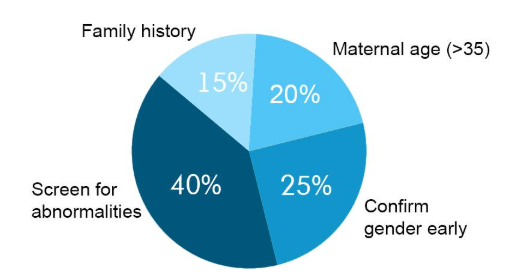
Pie chart showing common reasons why parents choose genetic testing
Each scan has its specific timing and purpose, from confirming your pregnancy early on, to monitoring growth and detecting any possible abnormalities.
1. The dating scan (First trimester)
When: Between 8 and 14 weeks of pregnancy
This is usually your first ultrasound. It confirms the pregnancy and helps your doctor estimate the expected due date (EDD) by measuring your baby’s size. It also checks:
- Whether the baby is developing inside the uterus (not ectopic)
- The presence of a heartbeat
- If you’re expecting twins or multiples
Can you tell the gender yet?
Not accurately. Between 11–14 weeks, some guesses are possible, but the accuracy is low because the baby’s genitalia are still developing and appear similar in both sexes.
Preparation tip:
You may be asked to drink water beforehand for a clearer image during the scan.
2. The anomaly (anatomy) scan
When: Between 18 and 22 weeks
This is the most detailed and exciting scan for most parents. It checks your baby’s entire anatomy, i.e., brain, spine, heart, limbs, and organs, to ensure everything is developing normally.
It also assesses:
- Placental position
- Amniotic fluid levels
- Blood flow through the umbilical cord
Can you find out the gender now?
Yes! This is when gender identification is most accurate (close to 100%), provided your baby’s position allows the sonographer to see clearly.
Preparation tip:
Wear comfortable clothing and come with a moderately full bladder if advised.
3. Growth and wellbeing scans (Third trimester)
When: From 24 weeks onward
These scans are done later in pregnancy to monitor your baby’s growth, weight, and wellbeing. They can also check blood flow between the placenta and baby using Doppler ultrasound.
Can gender still be confirmed?
Yes. The gender can still be seen clearly, but by this stage, most parents already know from the earlier anomaly scan. The main focus now is ensuring the baby continues to grow well and remains healthy.
Summary: Common pregnancy scans and gender accuracy
| Scan Type | Timing | Main Purpose | Gender Accuracy | Preparation |
|---|---|---|---|---|
| Dating Scan | 8–14 weeks | Confirm due date, heartbeat, multiples | Low (11–14 weeks only) | Full bladder |
| Anomaly Scan | 18–22 weeks | Check baby’s organs and growth | Excellent (near 100%) | Moderately full bladder |
| Growth Scan | 24–41 weeks | Monitor growth and placenta | Very accurate | Standard scan |
4. Beyond ultrasound: Genetic and chromosomal tests
In addition to ultrasound imaging, some parents choose or are recommended to do genetic screening to check for potential inherited or chromosomal conditions.

Chart showing a relative comparison between non-invasive and invasive scans
These tests can also reveal your baby’s gender, sometimes as early as seven weeks.
a) Non-invasive prenatal testing (NIPT)
When: From 7 weeks
Type: Simple blood test (from the mother)
What it checks:
Tiny fragments of your baby’s DNA circulating in your bloodstream. NIPT screens for:
- Down syndrome (Trisomy 21)
- Edwards syndrome (Trisomy 18)
- Patau syndrome (Trisomy 13)
Accuracy: Over 99% for gender, and very reliable for chromosomal conditions.
Risk: None. It’s completely safe and non-invasive.
b) Chorionic villus sampling (CVS)
When: Around 10–13 weeks
Type: Diagnostic and invasive test
A small sample of tissue is taken from the placenta using a thin needle.
It provides definitive genetic information, checking for chromosomal or inherited disorders such as thalassemia or cystic fibrosis.
Accuracy: 100% for both genetic diagnosis and gender.
Risk: Small miscarriage risk (0.5–1%).
c) Amniocentesis
When: Around 15–20 weeks
Type: Diagnostic and invasive test
A small sample of amniotic fluid is drawn under ultrasound guidance to study the baby’s chromosomes.
It helps confirm or rule out conditions such as Down syndrome or neural tube defects.
Accuracy: 100% definitive.
Risk: Slightly lower than CVS (0.25–0.5% miscarriage risk).
Summary: Genetic and diagnostic tests
| Test | Earliest Timing | Type | Purpose | Gender Accuracy | Risk Level |
|---|---|---|---|---|---|
| NIPT | 7 weeks | Non-invasive (blood test) | Screen for chromosomal abnormalities | >99% | None |
| CVS | 10+ weeks | Invasive | Diagnose genetic disorders | 100% | 0.5–1% |
| Amniocentesis | 15+ weeks | Invasive | Confirm chromosomal/genetic conditions | 100% | 0.25–0.5% |
5. Which tests do you really need?
Most healthy pregnancies only require routine ultrasound scans, as these are enough to track your baby’s development and confirm gender.
Your doctor may recommend additional tests like NIPT, CVS, or amniocentesis if:
- You’re over 35 years old
- There’s a family history of genetic disorders
- You had abnormal scan or screening results
Always discuss your options with your obstetrician or maternal-fetal specialist. Every pregnancy is unique, and your care plan should be too.
Frequenty Asked Questions (FAQ) on pregnancy scans
You can usually check your baby’s gender as early as 14 to 16 weeks of pregnancy, though most clinics recommend waiting until 18–20 weeks for clearer results.
Accuracy is typically 90–99% after 18 weeks, depending on the baby’s position and the quality of the ultrasound machine.
A 2D scan is the most common and reliable for gender checking, while 3D or 4D scans give more detailed images for fun viewing and confirmation.
Yes! If your baby’s legs are crossed or the position is awkward, the doctor might not be able to see clearly.
For early scans, a partly full bladder can help get a clearer image. Later scans (after 18 weeks) usually don’t need it.
Yes, it’s legal in Malaysia, but clinics focus mainly on your baby’s health and development first.
Gender scans usually cost RM50–RM250, depending on the clinic, scan type (2D, 3D, 4D), and whether it’s part of a package.
Yes, most routine mid-pregnancy scans (around 18–22 weeks) can show gender, though it’s not the main purpose of the scan.
Yes, many private clinics offer early gender scans from 14 weeks, but accuracy improves with baby growth — better after 18 weeks.
Having a light snack before your scan can help your baby move a bit more, which sometimes makes it easier to see clearly.
Usually yes, if the baby’s position allows it. Anomaly and growth scans can often confirm the gender again.
Ultrasound scans are safe and non-invasive, but the main limitation is unclear visibility due to baby position or low amniotic fluid.
Yes, your doctor may suggest a repeat scan after one or two weeks for a clearer view.
Final thoughts
While learning your baby’s gender is exciting, the main goal of every scan and test is to protect your baby’s health and give parents peace of mind. So, enjoy every ultrasound, as each one marks another step in your journey toward welcoming your little one into the world.
At Metro IVF, we believe every pregnancy deserves the best start. Our experienced specialists offer comprehensive prenatal scans, NIPT, and genetic screening to ensure both mother and baby are healthy.
Start Your Journey Today
Take the first step towards parenthood with confidence. Contact Metro IVF to schedule a consultation and explore our fertility testing options tailored to your needs.

