Table of Contents
Understanding Reproduction and Natural Fertility
Human reproduction is an amazing biological process where a sperm cell from the man fertilises an egg cell from the woman – resulting in new life. To understand how to conceive naturally, it helps to know how the male and female bodies work together.

Figure depicting the human reproductive process
The Man’s role in reproduction
- The testes produce sperm.
- Sperm mature in the epididymis and travel through tubes during ejaculation.
- Accessory glands (like the prostate) add protective and nourishing fluids to sperm, creating semen.
- Testosterone (the main male hormone) drives sperm production and male traits.
- Healthy sperm production takes ~3 months, so lifestyle habits affect sperm weeks before ejaculation.
The Woman’s role in reproduction
- Women are born with all their eggs, stored in the ovaries.
- Each month, one egg matures and is released (ovulation).
- The fallopian tube carries the egg to the uterus, where it may meet sperm.
- If fertilised, the egg implants in the uterus lining, developing into an embryo and then a baby.
How does pregnancy occur?
- Fertilisation usually occurs in the fallopian tube.
- Out of millions of sperm, only one fertilises the egg.
- The fertilised egg (zygote) travels to the uterus and implants in the lining, starting pregnancy.
When is the right time for sex?
- Best chance to become pregnant is during the fertile window (about 5 days before ovulation plus the day of ovulation).
- Sperm can live up to 5 days, but the egg only survives 12–24 hours.
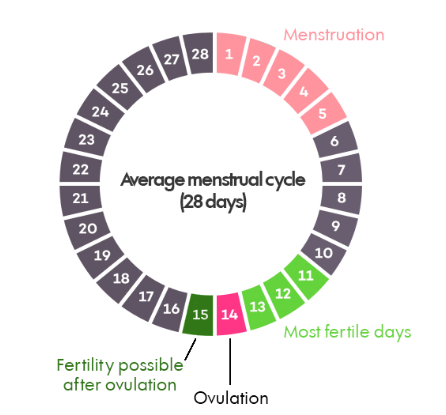
Diagram showing an average menstrual cycle, including the fertility window and ovulation day. It is important to note that menstrual cycle may differ from one person to another.
What tools can I use to track ovulation?
Since timing is crucial for getting pregnant, it’s important to know when you’re ovulating. The good news is there are many simple tools and methods to help you find out.
Menstrual Cycle Tracking
- Record the start date of your period each month to estimate ovulation.
- Most women ovulate ~14 days before their next period.
- Works best with regular cycles.
- Apps can help estimate, but combining with other methods improves accuracy.
Ovulation Predictor Kits (OPKs)
- Urine tests (like pregnancy tests) that detect a surge in Luteinizing Hormone (LH) 24–36 hours before ovulation.
- Pinpoints best time for intercourse to increase pregnancy chances.
- Very accurate for most, but results can be unclear with PCOS or irregular cycles.
Checking Cervical Mucus
- Mucus changes throughout the month; near ovulation it becomes clear, stretchy, and slippery – like raw egg whites.
- This helps sperm swim towards the egg.
- Check daily using toilet paper or fingers to identify fertile days.
- Infections, medications, or dehydration can affect mucus quality.
Basal Body Temperature (BBT)
- Take your temperature first thing in the morning before getting out of bed using a BBT thermometer.
- After ovulation, temperature rises by ~0.4–1°C due to progesterone.
- Confirms ovulation has occurred but does not predict it in advance for that cycle.
- Tracking over a few months helps understand your cycle for future planning.
How to boost natural fertility
- Eat well
- Balanced diets (e.g. Mediterranean diet) improve sperm and egg quality.
- Include fruits, vegetables, whole grains, fish, healthy fats, and folic acid.
- Stay active — but not excessively
- Moderate exercise keeps hormones balanced.
- Excessive intense training can harm fertility.
- Maintain a healthy weight
- Being overweight or underweight can disrupt hormones and ovulation.
- Aim for a BMI between 18.5–24.9.
- Prioritise sleep & manage stress
- Poor sleep and chronic stress affect hormones.
- Aim for 7–8 hours of sleep; manage stress via yoga, meditation, or relaxation.
- Avoid harmful substances
- Quit smoking – it damages eggs and sperm.
- Limit alcohol – less than 11 units a week.
- Reduce caffeine – less than 200 mg/day (~2 cups of coffee).
- Minimise exposure to toxins (pesticides, plastic chemicals, heavy metals) by choosing fresh, less processed foods.
Key Takeaway
Conception depends on healthy sperm and eggs, good timing, balanced hormones, and a supportive lifestyle. Small changes – better diet, healthier habits, and stress management – can make a big difference on your journey to parenthood.
When to Seek Help
If you’ve been trying to conceive for 12 months (or 6 months if you’re over 35) without success, or if you have known issues like irregular periods, PCOS, or endometriosis, it’s time to consult a fertility specialist such as Metro IVF. Our experienced team offers important fertility screening tests and personalised recommendations to help you achieve your dream of starting a family.
Start Your Journey Today
Take the first step towards parenthood with confidence. Contact Metro IVF to schedule a consultation and explore our fertility testing options tailored to your needs.

